Optimizing United Airlines San Francisco Routes Over Time
San Francisco International Airport serves as one of the primary transpacific gateways for United Airlines, connecting North American travelers with destinations across Asia, Europe, and the Americas. For frequent flyers and business travelers, navigating this massive hub requires more than just booking a ticket when a trip arises. Developing a long-term strategy for United Airlines routes out of San Francisco involves understanding hub economics, tier progression, scheduling nuances, and tactical redemption patterns that improve travel experiences incrementally over months and years.
Achieving better results over time means moving beyond transactional bookings to build an ongoing relationship with the airline and its operational ecosystem. Whether your goal is securing consistent upgrades, minimizing travel disruptions during foggy weather seasons, or maximizing loyalty currency value, a systematic approach yields compounding benefits. This guide explores the foundational mechanisms and advanced habits that help frequent flyers extract maximum value from United operations at San Francisco.
Understanding the SFO Hub Dynamics
San Francisco International Airport functions as a major operational nexus for United Airlines, creating distinct advantages and challenges for travelers originating or connecting there. Hub operations mean that a high volume of flights converge during specific banks of time, particularly during morning domestic departures and late afternoon transpacific banks. Understanding how these banks operate allows travelers to anticipate congestion, gate changes, and potential cascading delays caused by air traffic control or weather patterns unique to the Bay Area.
The geography of San Francisco introduces specific meteorological factors that influence route reliability. Coastal marine layers and morning fog frequently reduce arrival rates, triggering Federal Aviation Administration ground delays that ripple across the entire domestic network. Travelers who build buffer time into their connections or select specific departure windows mitigate the risk of missed itineraries. Over time, observing these operational rhythms helps frequent flyers choose flight times that statistically maintain better on-time performance.
Hub status also dictates aircraft rotation and fleet assignment on specific routes. High-demand business markets often feature widebody aircraft equipped with premium configurations, while regional routes rely on smaller narrowbody or regional jet equipment. Recognizing these deployment patterns enables travelers to select routes that offer superior seating options, enhanced amenities, and greater likelihood of operational recovery when technical issues arise.
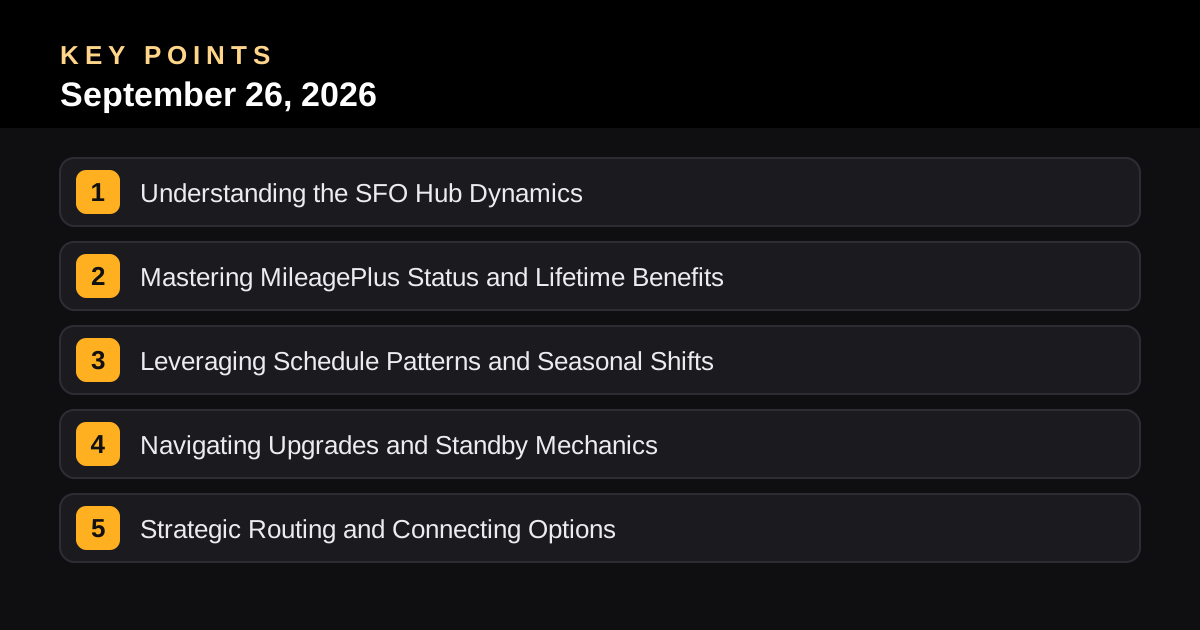
Mastering MileagePlus Status and Lifetime Benefits
Building long-term value within the MileagePlus program requires a clear understanding of Premier qualifying metrics, which combine flight segments and spending thresholds. As travelers accumulate status over successive years, the privileges scale from basic economy waivers and complimentary space-available upgrades to priority boarding and dedicated phone lines. Achieving higher tiers changes how travelers interact with San Francisco routes, providing access to premier check-in areas and expedited security lanes that dramatically reduce airport friction.
Long-term loyalty strategies also incorporate lifetime mileage tracking, which rewards consistent multi-year commitment regardless of annual fluctuations in travel volume. Reaching milestone thresholds locks in permanent status benefits, ensuring baseline privileges persist even if career or personal travel patterns shift. To accelerate this progression efficiently, flyers can utilize co-branded credit cards and everyday spending multipliers that contribute toward qualifying thresholds without requiring additional flights.
Key components of a progressive loyalty strategy include:
- Targeting specific flight frequencies that maximize Premier Qualifying Flights and Premier Qualifying Points.
- Utilizing partner airline flights credited to MileagePlus to capture promotional accelerators.
- Auditing account statements quarterly to ensure proper credit crediting and missing mileage claims.
Leveraging Schedule Patterns and Seasonal Shifts
Airlines adjust their route networks seasonally, introducing new nonstop destinations or altering frequencies based on shifting passenger demand and aircraft availability. As route networks evolve heading into 2026, summer schedules typically feature expanded transpacific and European frequencies, while winter months see adjustments toward leisure warm-weather markets or reduced frequencies on business-heavy corridors. Tracking these annual cycles helps travelers anticipate when new direct routes might appear or when capacity changes will alter award seat availability.
Beyond major seasonal overhauls, flight schedules follow weekly patterns that influence both pricing and upgrade success rates. Mid-week departures on Tuesdays and Wednesdays often experience lower business demand, resulting in less crowded cabins and higher clearance rates for complimentary upgrades. Conversely, Sunday evening and Monday morning peaks command premium pricing and fierce competition for elite benefits, making flexible scheduling an essential tool for long-term travel optimization.
Over time, observant flyers notice how schedule modifications affect connecting times and minimum connection requirements at San Francisco. When airlines tighten or loosen flight banks, the risk of misconnects changes. By reviewing schedule stability indices or choosing flights with multiple daily backup frequencies, travelers protect themselves against unexpected itinerary disruptions and maintain greater control over their travel timeline.
Navigating Upgrades and Standby Mechanics
Securing premium cabin seating on competitive San Francisco routes requires more than simply requesting an upgrade at booking. Complimentary Premier Upgrades clear according to status tier, fare class, and time of request, creating a hierarchy that favors informed booking choices. Purchasing higher economy fare classes or utilizing eligible electronic upgrade instruments significantly improves clearance priority over lower fare buckets on the same route.
Standby mechanics and same-day flight changes represent another area where long-term familiarity pays dividends. United permits eligible elite members to confirm alternate same-day flights without penalty under specific conditions, allowing travelers to pivot away from delayed or crowded itineraries. Knowing the exact rules governing fare class availability for same-day changes prevents frustrating gate interactions and ensures stranded travelers secure seats on earlier departures before standby lists fill up.
When upgrades fail to clear automatically, understanding airport-level waitlist dynamics helps. The upgrade list updates dynamically as check-in closes and operational constraints become clear. Monitoring the list via mobile applications provides real-time visibility into seat inventory and clearing status, allowing travelers to make informed decisions about whether to approach gate agents or wait for automated processing.
Strategic Routing and Connecting Options
While nonstop flights from San Francisco provide the most direct travel experience, strategic connecting itineraries can sometimes offer financial or logistical advantages. Connecting through alternative hubs like Denver, Chicago, or Houston can occasionally provide lower fare structures or access to different aircraft types equipped with specialized polar or domestic first-class seating. Over time, evaluating alternative routings expands flexibility when primary direct flights are sold out or prohibitively expensive.
When connections are necessary, mastering terminal geography and minimum connection times at San Francisco or other hubs prevents unnecessary stress. San Francisco features a centralized layout connected by walkways and airside transit options, but international arrivals requiring customs clearance demand additional transition time. Factoring these operational realities into initial booking decisions ensures realistic itineraries that withstand minor delays.
Effective routing strategies incorporate several tactical rules:
- Prioritizing itineraries with sufficient buffer times when transiting through weather-prone coastal hubs.
- Comparing multi-city pricing structures against round-trip tickets for complex travel requirements.
- Utilizing alliance partner connections to access secondary international cities without backtracking through major European gateways.
Tracking Evolving Partner Networks and Alliances
United Airlines operates within the Star Alliance, a vast global network that expands travel possibilities far beyond its own direct route map. For flyers based in San Francisco, leveraging partner airlines opens up seamless connections to destinations across Asia, Europe, and Africa via joint ventures and codeshare agreements. Over time, learning how to book partner award space and earn loyalty credit across multiple carriers unlocks superior routing options and better redemption value.
Redeeming MileagePlus miles on partner airlines often requires understanding different award availability rules and booking windows compared to purely domestic itineraries. Partners may release space at varying intervals, and their onboard product standards differ significantly. Researching partner aircraft configurations and lounge access policies ensures that long-haul journeys booked with miles meet personal comfort expectations and deliver maximum return on accumulated points.
Furthermore, alliance status recognition provides tangible benefits when traveling on partner metal abroad. Star Alliance Gold status, earned through United Premier tiers, grants lounge access, priority baggage handling, and fast-track security globally. Cultivating an understanding of how these privileges apply across different international carriers transforms foreign airport experiences and simplifies complex global travel schedules over years of frequent flying.
Mastering United Airlines routes out of San Francisco is a cumulative process that rewards patience, observation, and strategic planning. By understanding hub operational realities, leveraging loyalty tiers, staying attuned to schedule shifts, and utilizing partner networks, frequent flyers can transform unpredictable travel into a streamlined, highly optimized experience. Over time, these deliberate habits compound into significant savings of time, stress, and resources.