Mastering Gait Efficiency: Optimizing Your Movement Mechanics Over Time
Human locomotion is a complex interplay of skeletal alignment, muscular coordination, and energy conservation. While walking appears effortless, subtle deviations in gait—such as excessive lateral pelvic tilt, often colloquially referred to as a waddle—can significantly impact long-term physical efficiency, joint health, and energy expenditure. Understanding these movement patterns is the first step toward achieving sustained improvements in physical performance and mobility over time.
Getting better results through gait optimization requires a systematic approach rather than quick fixes. By examining how biomechanical forces interact across the hips, core, and lower extremities, individuals can identify inefficiencies and implement progressive corrective strategies. This guide explores the foundational principles of movement efficiency, providing actionable insights to help you refine your walking mechanics, build foundational stability, and track your progress effectively over the long term.
Understanding the Mechanics of Human Locomotion
To improve your walking efficiency over time, it is essential to first understand the foundational mechanics of human movement. Locomotion relies on a synchronized sequence of events known as the gait cycle, which is divided into stance and swing phases. During the stance phase, the foot makes contact with the ground, absorbing shock and transitioning weight forward, while the swing phase involves the leg moving forward to prepare for the next step. Every component of this cycle depends on precise coordination between the nervous system and the musculoskeletal framework.
When this coordination is disrupted—due to muscular imbalances, fatigue, or postural habits—compensatory patterns emerge. One common compensatory mechanism is an exaggerated side-to-side sway, which alters the body's center of mass. While a minor degree of pelvic rotation is entirely natural and necessary for forward momentum, excessive lateral shifting increases the workload on stabilizing muscles. Recognizing the difference between natural pelvic tilt and inefficient mechanical deviations allows you to target the root causes of movement fatigue rather than merely addressing surface symptoms.
Achieving sustainable improvements requires looking closely at how energy is transferred from the ground up. The kinetic chain connects the ankles, knees, hips, and spine into a single functional unit. If stability is compromised at any point along this chain—most notably in the pelvis and hips—the body naturally seeks alternative pathways to maintain balance, often resulting in increased lateral displacement. By establishing baseline metrics of your current movement patterns, you create a reliable foundation for measuring future progress and refining your technique.
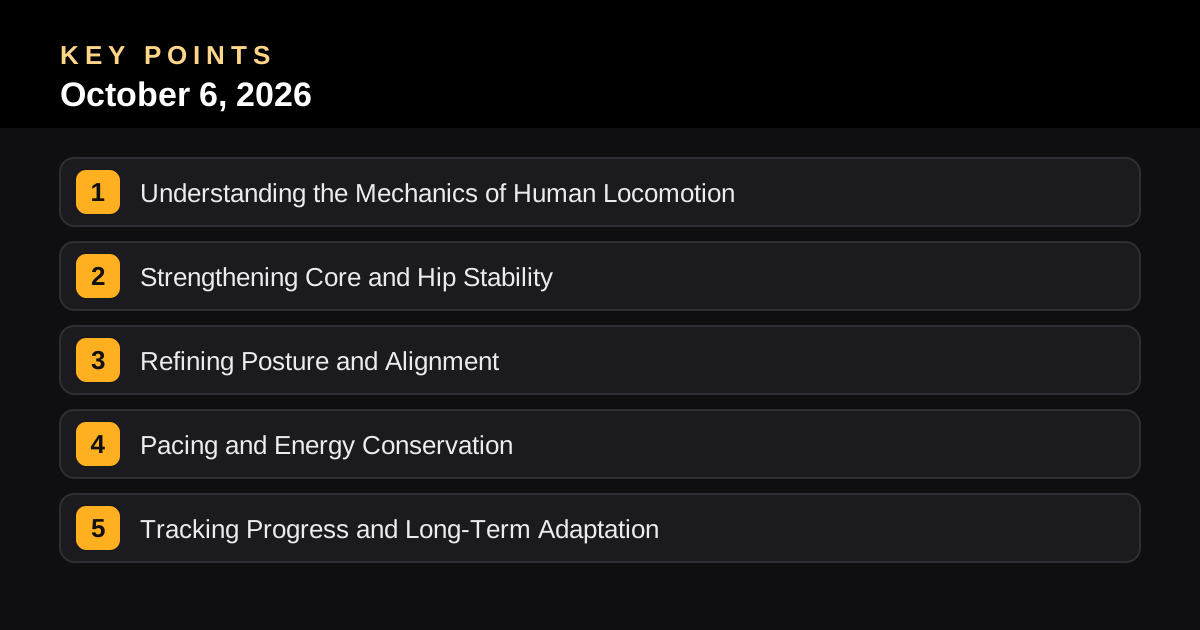
Strengthening Core and Hip Stability
The primary driver behind excessive lateral sway during movement is a lack of adequate stabilization in the core and hip abductor muscles, particularly the gluteus medius. These muscles are responsible for keeping the pelvis level when you stand, walk, or run on a single leg. When they lack sufficient strength or endurance, the pelvis drops on the unsupported side, forcing the torso to lean in the opposite direction to compensate. Strengthening this specific muscle group is essential for achieving a smoother, more efficient gait over time.
Implementing a targeted conditioning program involves progressive overload, where resistance and complexity are gradually increased to stimulate muscle adaptation. Consistency is far more critical than intensity during the initial phases of training. Integrating specialized exercises into your weekly routine helps retrain neuromuscular pathways, ensuring that stabilizing muscles activate automatically during everyday movement rather than requiring conscious effort.
- Single-leg balance holds to improve proprioception and ankle stability
- Controlled lateral band walks to activate the gluteus medius
- Planks and dead bugs to build deep core and spinal stabilization
- Step-downs to enhance eccentric quadriceps and hip control
As these stabilizing muscles grow stronger, the physical manifestation of an inefficient gait diminishes naturally. You will notice a reduction in lateral movement, allowing your center of mass to travel in a more direct, linear path forward. This mechanical efficiency translates directly into reduced fatigue over long distances, lower impact stress on the lower back and knees, and an overall improvement in functional endurance. Monitoring these changes through periodic self-assessments or professional gait analyses ensures that your conditioning efforts are yielding measurable results.
Refining Posture and Alignment
Beyond muscular strength, overall postural alignment plays a critical role in determining how efficiently you move. Many individuals carry habitual tension or postural misalignments—such as forward head carriage, rounded shoulders, or anterior pelvic tilt—that disrupt the natural vertical stacking of the skeleton. When the skeletal framework is misaligned, gravity exerts uneven forces across the joints, forcing the musculature to work harder simply to maintain upright posture during locomotion. Without active intervention, these postural deviations become deeply ingrained, creating persistent wear and tear on weight-bearing joints.
Correcting postural alignment requires a combination of mobility work and conscious neuromuscular re-education. Tight hip flexors, restricted thoracic mobility, and stiff ankles are common culprits that restrict the natural range of motion required for an optimal stride. By incorporating daily mobility routines that address these specific tight spots, you create the physical capacity needed for better alignment. Over time, maintaining a neutral spine and an open chest shifts the body's center of gravity back to its optimal position, reducing unnecessary compensatory movements.
Integrating postural awareness into daily activities reinforces these physical changes. Whether you are sitting at a desk or walking outdoors, checking in on your structural alignment helps solidify new motor patterns. Small adjustments—such as engaging the lower abdominals, keeping the gaze focused straight ahead, and allowing the arms to swing naturally—compound over time. This continuous refinement transforms mechanical efficiency from a conscious effort into an automatic, ingrained habit.
Pacing and Energy Conservation
Efficiency is not solely about mechanics and strength; it is also profoundly influenced by pacing, cadence, and energy management. Many people fall into the trap of overstriding, where the foot lands too far in front of the body's center of mass. Overstriding acts as a braking mechanism with every step, generating high impact shockwaves that travel up the kinetic chain and drain metabolic energy. Optimizing your cadence—the number of steps taken per minute—is one of the most effective ways to eliminate braking forces and conserve energy over time.
Transitioning to a more efficient stride rate requires patience and deliberate practice. Rather than making drastic changes overnight, focus on incremental adjustments. Small increases in step frequency combined with a slightly shorter, more compact stride help keep your center of mass balanced directly over your support base. This approach minimizes vertical oscillation, meaning you spend less energy bouncing up and down and more energy moving forward efficiently.
- Gradually increasing step frequency by five percent during routine walks
- Focusing on a midfoot strike directly beneath the torso
- Relaxing the upper body and shoulders to prevent energy-wasting tension
- Utilizing rhythmic breathing patterns to maintain steady exertion levels
Documenting your pacing metrics allows you to evaluate your progress objectively. Whether you track time, distance, or perceived exertion, maintaining a training log provides valuable feedback on your cardiovascular and mechanical efficiency. Over months of consistent practice, the body adapts to these optimized movement rhythms, resulting in decreased heart rate responses at identical speeds and a noticeable enhancement in overall movement stamina.
Tracking Progress and Long-Term Adaptation
Achieving lasting improvements in any physical discipline requires structured tracking and periodic evaluation. Without a reliable method for measuring progress, it is easy to stagnate or misjudge the effectiveness of your training interventions. Long-term adaptation occurs gradually at the cellular, neuromuscular, and structural levels, meaning that visible or physical changes often manifest slowly over months of consistent effort. Establishing clear milestones helps maintain motivation and provides a roadmap for ongoing refinement.
A comprehensive tracking strategy should combine qualitative self-observations with quantitative metrics. Periodically recording video of your movement from multiple angles allows you to visually analyze changes in lateral sway, stride length, and postural alignment over time. Comparing footage captured months apart provides undeniable evidence of mechanical improvement. Additionally, tracking qualitative factors such as post-activity fatigue levels, muscle soreness patterns, and overall joint comfort offers essential feedback on how well your body is tolerating increased efficiency.
Sustaining these results over the long term requires viewing movement optimization as an ongoing practice rather than a finite project. As physical conditioning improves, new opportunities for refinement will naturally emerge. By remaining adaptable, listening to physiological feedback, and continuously fine-tuning your strength, posture, and pacing, you ensure that your physical capabilities continue to evolve positively. The cumulative effect of these small, consistent adjustments is a resilient, highly efficient movement system capable of supporting lifelong mobility.
Optimizing your movement mechanics and addressing inefficiencies like excessive lateral sway requires a deliberate, multi-faceted approach. By focusing on core stabilization, postural alignment, pacing cadence, and consistent tracking, you can achieve remarkable improvements in energy efficiency and physical endurance over time. True physical mastery is not achieved overnight, but rather through the steady accumulation of mindful habits and dedicated practice, ensuring long-term mobility, reduced injury risk, and sustained physical vitality.