Avoiding Common Analytical Mistakes When Interpreting GDP Data
Gross Domestic Product, or GDP, remains one of the most widely cited metrics in global economics. Whether evaluating national prosperity, formulating monetary policy, or making long-term business investments, analysts across both the public and private sectors rely heavily on this figure to gauge overall macroeconomic health. In essence, GDP measures the total monetary value of all finished goods and services produced within a domestic boundary during a specific timeframe. As global economies grow increasingly complex, digitalized, and interconnected, interpreting this headline metric requires careful analytical nuance rather than superficial observation.
Despite its ubiquity, GDP is frequently misunderstood and misapplied in professional settings. Analysts, financial journalists, and policymakers often fall into predictable analytical traps, drawing sweeping conclusions from raw data without accounting for structural limitations, inflation distortions, or broader social realities. By recognizing these common analytical errors, professionals can develop a much more accurate, balanced understanding of economic performance. The following breakdown explores the most frequent mistakes made when analyzing GDP and provides actionable strategies for avoiding them in modern economic evaluation.
Interpreting GDP as a Measure of Standard of Living
One of the most persistent errors in economic analysis is treating GDP as a direct proxy for human wellbeing, happiness, or overall societal progress. While higher economic output generally correlates with improved public infrastructure and greater resource availability, GDP was never designed to measure quality of life. It does not account for environmental degradation, leisure time, health outcomes, educational attainment, or the equitable distribution of wealth among citizens. Consequently, a national economy can experience significant GDP growth while a large portion of its population faces declining purchasing power, increased stress, or deteriorating living conditions.
To avoid this mistake, analysts must strictly separate aggregate economic output from broader social welfare. When evaluating national progress, GDP figures should always be examined alongside complementary metrics such as the Human Development Index, average life expectancy, and income distribution indicators. Recognizing that raw production does not equal societal contentment prevents misleading policy conclusions and ensures a holistic assessment of a nation's true health.
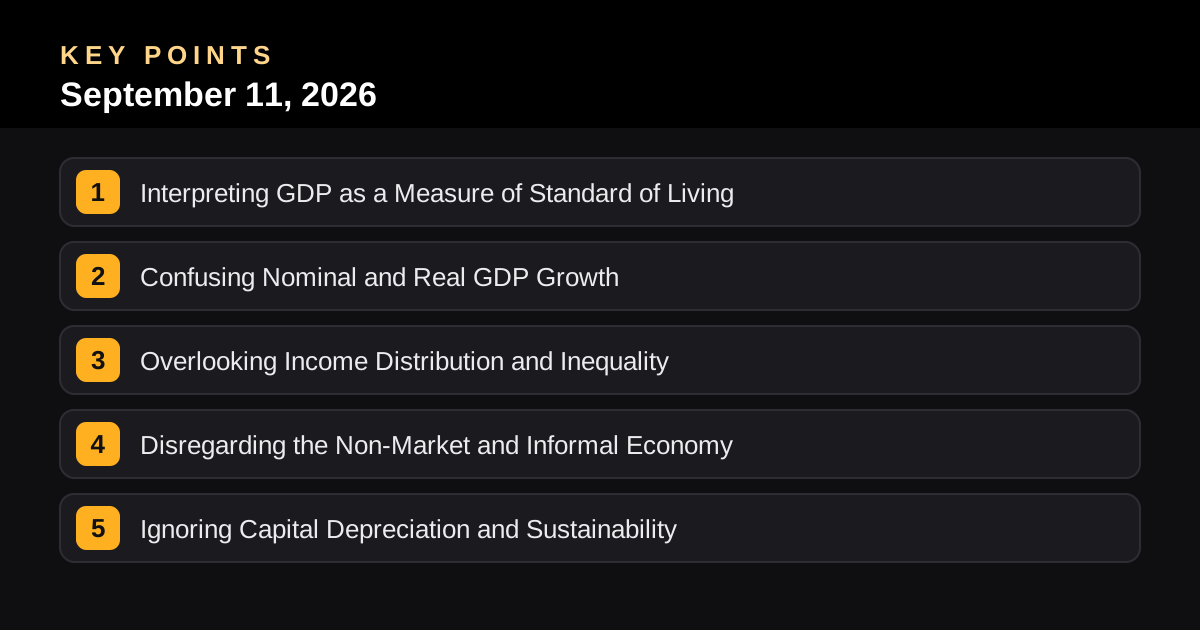
Confusing Nominal and Real GDP Growth
Failing to distinguish between nominal GDP and real GDP is a classic analytical stumble that can severely distort long-term trend analysis. Nominal GDP measures the value of goods and services at current market prices, meaning it inherently includes the effects of inflation. Real GDP, by contrast, adjusts for price changes over time, providing a true reflection of physical output changes. Looking only at nominal figures during periods of high price volatility creates an illusion of booming economic growth when, in reality, physical production may be stagnant or even contracting.
When evaluating economic growth rates, professionals should always verify whether the reported figures are inflation-adjusted. Key steps to prevent this error include:
- Always checking the baseline year and methodology used for price deflators and chain-weighted indexes.
- Comparing nominal expansion rates against current consumer price and producer price inflation metrics.
- Focusing on real per capita figures to isolate genuine output gains from population growth and price inflation.
Overlooking Income Distribution and Inequality
Relying exclusively on aggregate GDP or even standard GDP per capita can mask severe economic disparities within a country. Aggregate numbers combine an entire nation's total output into a single figure, hiding whether economic gains are concentrated among a tiny fraction of the population or distributed broadly across the middle and lower classes. An economy can post impressive headline growth driven by booming high-tech sectors or financial markets, while ordinary workers experience stagnant wages and a rising cost of living that erodes their financial security.
To overcome this blind spot, analysts should look beyond aggregate totals and incorporate distributional metrics into their research. Reviewing median income trends, poverty rates, and regional economic breakdowns offers a much clearer picture of how economic growth is experienced on the ground. Understanding who actually captures the benefits of economic expansion prevents overly optimistic assessments of domestic market stability and consumer demand.
Disregarding the Non-Market and Informal Economy
Another frequent limitation of standard GDP accounting is its inability to capture non-market transactions, informal labor, and domestic work. Official GDP calculations typically rely on registered commercial transactions, taxation records, and formal corporate surveys. Consequently, unpaid care work, DIY home improvements, volunteer services, and the extensive underground or informal economy are largely excluded from official totals. In emerging markets, or regions with large informal labor sectors, official GDP figures may severely understate the true scope of economic activity.
Analysts working with developing economies or specific localized markets must acknowledge these structural omissions. While formal institutional data remains essential for macroeconomic tracking, recognizing the scale of the informal sector helps contextualize employment figures and consumer spending behavior. Avoiding rigid reliance on official statistics alone prevents misjudging the resilience, adaptability, and resourcefulness of local economic networks.
Ignoring Capital Depreciation and Sustainability
Traditional GDP measures gross output rather than net resource creation, meaning it fails to account for the depreciation of physical capital and the depletion of natural resources. If a country accelerates production by rapidly exhausting its non-renewable energy reserves or allowing public infrastructure to crumble without repair, its short-term GDP will rise. However, this growth comes at the direct expense of long-term productive capacity and ecological stability. Treating gross output as net income is a dangerous accounting illusion that can disguise structural decline as progress.
To avoid this oversight, forward-looking analysts incorporate environmental and capital depreciation metrics into their evaluations. Whenever possible, consider Net Domestic Product, which subtracts capital consumption allowance from gross output figures. Furthermore, factoring in resource depletion and environmental degradation ensures that economic models align with sustainable long-term development goals rather than short-term output maximization.
Overreacting to Initial Quarterly Revisions
Economic data is rarely final when first published, yet market participants and analysts frequently overreact to preliminary GDP releases. National statistical agencies typically release multiple revisions of quarterly GDP data as more comprehensive source information becomes available over subsequent months. Initial estimates are often based on incomplete surveys and preliminary models, making them prone to significant statistical noise and subsequent upward or downward correction.
Making high-stakes financial or policy decisions based solely on the first print of a single quarter's GDP can lead to erratic strategy shifts. To mitigate this risk, professionals should adopt a patient, multi-layered approach to data consumption:
- Wait for secondary and tertiary revisions before drawing definitive macroeconomic conclusions.
- Track moving averages and year-over-year trends rather than focusing exclusively on short-term quarter-over-quarter volatility.
- Triangulate GDP prints with coincident indicators such as employment reports, industrial production, and retail sales data to confirm underlying economic direction.
Gross Domestic Product remains an indispensable pillar of macroeconomic analysis, providing a standardized framework for tracking national output and economic activity. However, treating GDP as an infallible, all-encompassing measure of national success invites serious analytical errors. By understanding its methodological limitations—such as ignoring inflation, inequality, environmental sustainability, and informal labor—analysts can build much more robust economic models. Approaching GDP data with appropriate skepticism, methodological rigor, and complementary indicators ensures clearer insights and better decision-making in an increasingly complex global economy.