Analyzing ServiceNow (NOW) Stock: A 2026 Practical Walkthrough
Investing in enterprise technology equities requires a structured, analytical approach that moves far beyond surface-level market sentiment and short-term price fluctuations. For individual and institutional investors evaluating ServiceNow, trading under the ticker symbol NOW, understanding how the company translates complex enterprise digital workflows into sustainable, recurring revenue is essential. As businesses worldwide continue to modernize legacy infrastructure and migrate operations to the cloud, workflow automation platforms occupy a critical, foundational layer of modern corporate technology architecture.
This practical walkthrough provides a methodical framework for analyzing NOW stock in 2026 within the context of current market conditions and long-term industry trends. By systematically breaking down fundamental business models, financial statements, competitive positioning, and valuation metrics, investors can build a rigorous and comprehensive analytical thesis. Whether you are updating an existing portfolio allocation or conducting preliminary research on software equities, this guide offers step-by-step guidance on how to evaluate the company objectively, manage investment risks, and make informed decisions.

Understanding the ServiceNow Business Model
To evaluate NOW stock effectively, you must first understand how ServiceNow generates revenue and delivers ongoing value to its large enterprise customer base. At its core, the company operates as a robust software-as-a-service provider, specializing in enterprise-grade digital workflow automation. Organizations use its centralized platform to connect disparate departments—such as human resources, customer service, security operations, and information technology—into a single, unified system of action. This business model relies heavily on multi-year subscription contracts, which provide high visibility, predictability, and recurring revenue streams that insulate the company from short-term economic shocks.
The primary operational driver of this business model is enterprise efficiency and consolidation. When a large corporation adopts these comprehensive workflow solutions, it typically replaces multiple fragmented legacy software tools and manual spreadsheets with a single, integrated environment. This consolidation drastically reduces operational friction, eliminates duplicate software licensing costs, and accelerates internal response times. Because these platforms become deeply embedded in daily corporate operations, customer retention rates tend to remain exceptionally high, creating a remarkably stable foundation for long-term financial growth and margin expansion across economic cycles.
When analyzing this segment, investors should look closely at annual contract value expansion rates, net retention metrics, and customer acquisition trends reported in quarterly financial filings. A healthy enterprise software company consistently demonstrates that existing customers buy more seats, deploy additional functional modules, or upgrade to higher-tier service packages over time. Examining customer cohort behavior and large-deal activity helps reveal whether the platform is truly mission-critical to its users or merely viewed as a peripheral utility, giving you a clearer picture of long-term business durability.
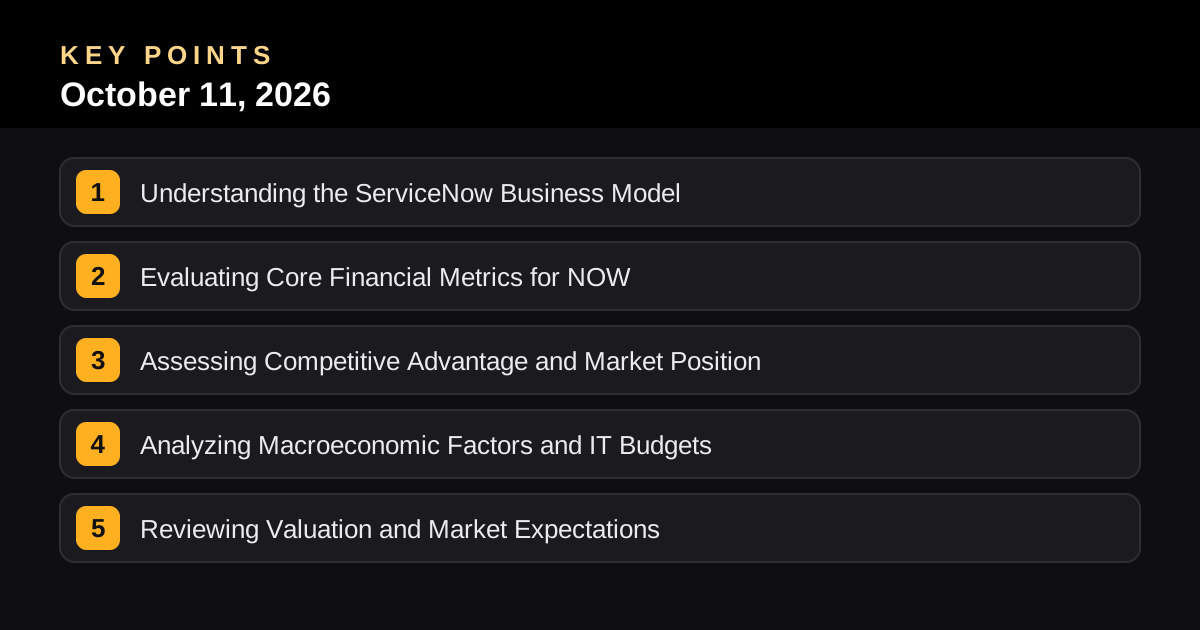
Evaluating Core Financial Metrics for NOW
Financial analysis of ServiceNow begins with a meticulous review of its income statement, balance sheet, and statement of cash flows. Unlike early-stage technology firms that prioritize rapid, burn-rate-heavy top-line growth at the expense of bottom-line discipline, mature enterprise software leaders successfully balance revenue expansion with strong operating margins. Subscription revenue growth serves as the primary gauge of commercial momentum, reflecting how successfully the global sales force acquires new enterprise clients and expands existing relationships across diverse geographic markets.
Operating margin and free cash flow generation are equally critical parameters for assessing financial health. As an enterprise software company scales its operations, its research and development expenses as a percentage of total revenue typically stabilize, allowing powerful operating leverage to take effect. Investors should monitor how efficiently management converts top-line revenue into actual operating cash flow, which provides the financial flexibility necessary for internal product reinvestment, strategic technology acquisitions, or shareholder capital return programs.
Key financial indicators to review during your thorough assessment include:
- Subscription revenue growth rate measured year-over-year in constant currency
- Non-GAAP operating margins and gross margins across core cloud products
- Free cash flow conversion relative to net income and total revenue
- Remaining performance obligations representing future contracted subscription revenue
Assessing Competitive Advantage and Market Position
Analyzing any growth stock requires evaluating its economic moat, which consists of the structural advantages that protect its market share from aggressive competitors. In the enterprise workflow market, ServiceNow benefits from significant switching costs. Once a large organization configures its internal IT service management, employee onboarding, security incident response, and customer support workflows around a specific cloud platform, migrating to a competing system involves substantial time, financial expense, and operational risk that most executives prefer to avoid.
Furthermore, the company operates within an expanding ecosystem that seamlessly integrates with major enterprise resource planning software suites, cloud infrastructure providers, and modern productivity tools. This interoperability ensures that the platform remains central to corporate technology stacks rather than operating in isolation. As artificial intelligence and automated decision-making tools become standard enterprise requirements, platforms capable of embedding these advanced capabilities directly into daily workflows maintain a distinct strategic advantage over point solutions that lack end-to-end integration capabilities.
Investors should monitor competitive pressures from other enterprise technology giants that offer overlapping workflow automation tools or platform-as-a-service offerings. While competition in the enterprise software sector is fierce, ServiceNow's specific focus on cross-departmental integration provides a targeted value proposition that appeals directly to chief information officers. Reviewing independent industry analyst reports, customer case studies, and partner ecosystem updates can help clarify whether the company is maintaining its competitive differentiation or facing pricing pressure from emerging rivals.
Analyzing Macroeconomic Factors and IT Budgets
Even the strongest software companies are inevitably influenced by macroeconomic conditions and broader corporate spending trends. Enterprise information technology budgets fluctuate based on overarching economic confidence, interest rate environments, and borrowing costs. During periods of economic uncertainty or tighter monetary policy, corporate buyers frequently scrutinize software expenditures more closely, which can lead to longer enterprise sales cycles, heightened budget approvals, and delayed contract renewals for non-essential applications.
Conversely, when companies prioritize cost reduction, automation, and operational efficiency, workflow automation platforms often receive dedicated funding because they directly reduce administrative overhead and headcount reliance. ServiceNow positions its comprehensive offerings as essential tools for driving productivity and consolidating software spend, which can help insulate its revenue streams during macroeconomic downturns. However, investors must still remain mindful of how external economic shifts impact enterprise software demand across different geographic regions and vertical industry sectors.
To gauge these macroeconomic trends effectively, review management commentary during quarterly earnings conference calls regarding enterprise spending behavior and sales cycle duration. Pay close attention to macroeconomic indicators that influence corporate investment decisions, such as business capital expenditures and executive sentiment surveys. Understanding how external economic pressures affect customer purchasing decisions allows for a more realistic appraisal of near-term stock performance and valuation resilience.
Reviewing Valuation and Market Expectations
Valuation bridges the gap between underlying business quality and stock price attractiveness. High-quality technology companies frequently trade at elevated valuation multiples due to their highly predictable subscription revenue streams and strong secular growth prospects. Common valuation metrics for software equities include price-to-earnings ratios, enterprise value to free cash flow multiples, and price-to-sales ratios adjusted for expected long-term growth rates.
When examining NOW stock, investors must determine whether current market prices accurately reflect future growth potential or if market expectations are overly optimistic. A company can exhibit exceptional operational performance and strong revenue growth while still representing a poor investment if its shares are purchased at an unsustainable valuation multiple. Comparing current valuation ratios against historical company averages and broader software peer group medians provides essential context for determining whether the stock trades at an attractive premium or an unjustified valuation extreme.
Actionable steps for conducting a thorough valuation analysis include:
- Calculating forward price-to-earnings ratios based on conservative consensus analyst estimates
- Evaluating enterprise value relative to projected free cash flow over a multi-year horizon
- Assessing how shifts in macroeconomic interest rates influence the present valuation of future technology cash flows
Developing a Practical Investment Strategy
Translating detailed analysis into a coherent investment strategy requires defining your personal risk tolerance, investment time horizon, and portfolio diversification goals. Owning individual equities inherently involves market volatility, particularly within the technology sector, where investor sentiment can shift rapidly based on macroeconomic headlines. Establishing clear entry and exit criteria helps prevent emotional decision-making during market corrections or sector rotations.
Rather than deploying capital all at once, many disciplined investors utilize a dollar-cost averaging approach, building a position in NOW stock gradually over several quarters. This strategy mitigates the risk of timing the market incorrectly and allows you to observe ongoing financial reports and execution milestones before committing significant capital. Monitoring quarterly earnings releases, product expansion announcements, and shifts in enterprise demand ensures that your core investment thesis remains valid over time.
Maintaining a balanced portfolio also means ensuring that no single stock dominates your overall asset allocation. Even high-performing enterprise software leaders should represent a measured percentage of a well-diversified portfolio that includes multiple market sectors and asset classes. By pairing rigorous fundamental research with disciplined risk management principles, you can approach NOW stock with clarity, confidence, and a long-term perspective.
Analyzing ServiceNow (NOW) stock requires a balanced, methodical examination of its subscription-based business model, underlying financial health, competitive moat, and market valuation. By following a structured, step-by-step evaluation process, investors can cut through short-term market noise and focus on the fundamental drivers of long-term business success. Whether you ultimately decide to invest, hold, or look elsewhere for opportunities, maintaining a disciplined and objective approach remains the cornerstone of sound financial decision-making.